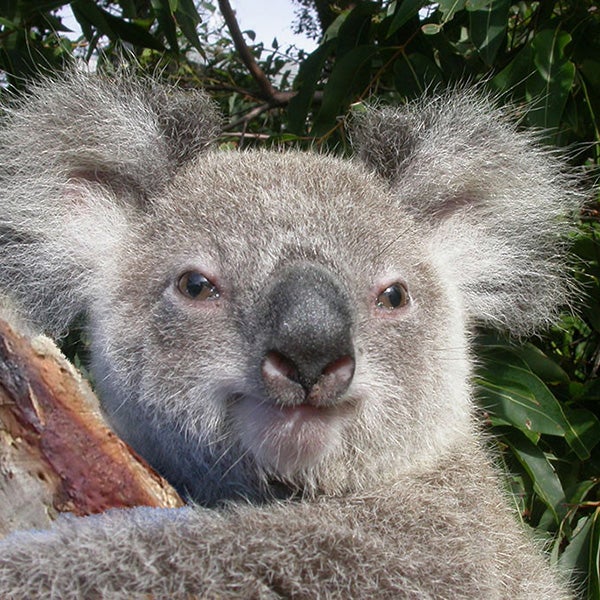
Transforming koala conservation through evolutionary and genomic science
Associate Professor Celine Frere has established an internationally recognised research program that translates evolutionary and genomic science into transformative conservation solutions for threatened wildlife, particularly koalas.
Her research has pioneered a suite of innovative, non-invasive tools for wildlife monitoring and health assessment, including:
- the use of detection dogs for habitat surveys
- disease surveillance from koala scats
- advanced genetic monitoring using next-generation sequencing
- airborne eDNA detection
- machine learning approaches for wildlife health diagnostics.
These innovations have reshaped how koalas are monitored and managed, and are now embedded within national and state conservation frameworks. The influence of this work extends well beyond academia, informing biodiversity assessment and conservation policy across 5 countries and contributing to 215 citations in 101 policy documents.
More recently, Dr Frere led the development of a novel machine learning-based health diagnostic tool that uses the koala gut microbiome to predict health and demographic characteristics from a single koala scat. This approach provides a powerful, scalable and entirely non-invasive alternative to costly and potentially stressful veterinary assessments, enabling the prediction of age, weight, body condition, reproductive status, chlamydial disease status and likely survival outcomes. By integrating genomics, microbiome science and artificial intelligence, this research creates unprecedented opportunities to monitor wildlife health at population scales and to detect emerging disease threats before population declines become apparent.
Collectively, this work is transforming the way conservation practitioners assess and manage threatened populations. It provides critical information to guide disease management, population recovery and habitat restoration efforts, while reducing the need for intensive animal handling. Importantly, the research demonstrates that effective conservation requires more than simply restoring vegetation; it requires restoring habitat in ways that actively support species health, genetic connectivity, adaptive capacity and long-term resilience.
By linking individual health, disease dynamics and habitat quality, Dr Frere's research is helping to establish a new generation of evidence-based conservation strategies that maximise the persistence of koalas in an increasingly human-modified and climate-challenged landscape.
Researcher

Associate Professor Celine Frere
Associate Professor, School of the Environment
Affiliate, Centre for Marine Science
Support koala research
Get in touch to discuss how you can make a difference.
Brenda Tournier
Associate Vice President, Advancement
b.tournier@uq.edu.au 0447 537 384