
Researchers have coupled molecular chains to a superconducting surface, opening a new avenue for investigating extremely small components for future quantum technologies.
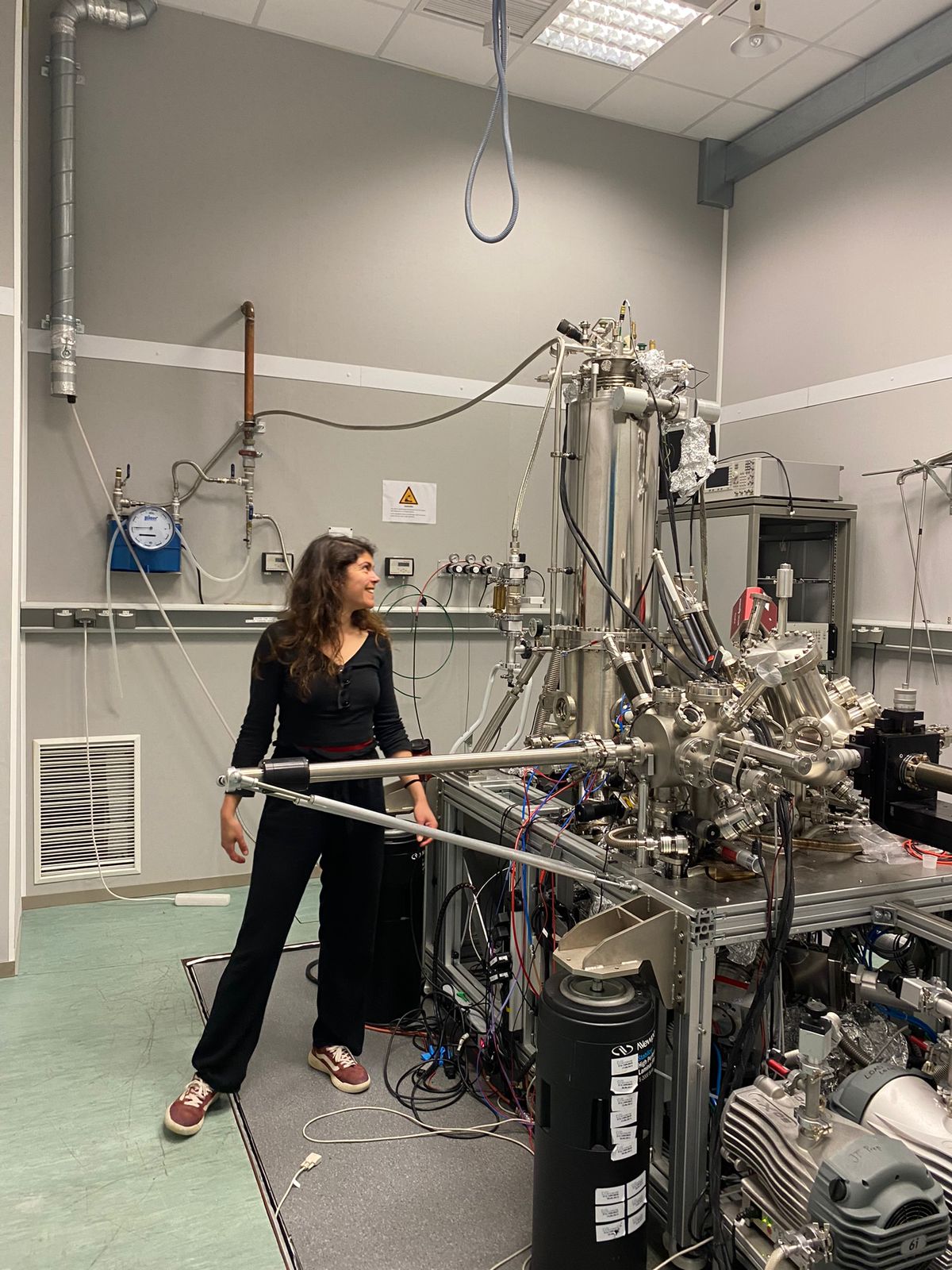
The groundbreaking work was led by Dr Katerina Vaxevani at CIC nanoGUNE-BRTA in Spain, shortly before she joined The University of Queensland’s School of Mathematics and Physics and Dr Peter Jacobson's Scanning Probe Microscopy and Quantum Technology (SPMQT) Lab.
The team constructed chains of a carbon-based molecule called triangulene on a gold surface engineered to exhibit superconducting properties.
Gold is not normally superconducting. In this system, the researchers grew the gold layer on an underlying superconducting material, allowing superconducting properties to be induced in the gold while retaining a surface well suited to constructing and studying molecules.
“Gold is a really useful surface for building and studying molecules,” Dr Vaxevani said.
“This approach allows us to work with molecules on a very clean and well-understood gold surface while also having access to superconductivity.
“The important step in this work is bringing the molecular chains and superconductivity together in the same system.
“The superconducting environment allows us to resolve features of the molecular chains that can otherwise be difficult to interpret and gives us a new way to investigate how their quantum states might eventually be controlled and read out.”
A key feature of the chains was an odd-even effect: their behaviour changed depending on whether the chain contained an odd or even number of molecular units.
This behaviour is associated with quantum spin states localised at the ends of the chains.
“By changing the length of the chain, we can change its quantum state,” Dr Vaxevani said.
“That gives us a remarkably precise way of exploring how quantum information could potentially be encoded and manipulated at the molecular scale.
“We are trying to understand how small the building blocks of future quantum technologies can ultimately become.
“If we can learn to reliably control and read quantum states using individual molecules, it could provide a route towards components whose properties can be engineered almost atom by atom.”
Dr Vaxevani said the work should be viewed as fundamental research rather than an immediately deployable quantum technology.
“The transistor did not immediately give us the smartphone, but understanding and controlling its underlying physics ultimately enabled technologies that transformed society,” she said.
“In the same way, understanding how quantum states behave and interact at this scale is part of the fundamental work needed to develop future quantum technologies.”
At UQ, Dr Vaxevani is now working in Dr Jacobson’s lab to explore how the superconducting platform developed in Spain could be incorporated into functional devices.
“Together with our collaborators at UQ, we are now investigating how this superconducting substrate could be integrated into devices relevant to future qubit technologies,” she said.
“Joining Peter’s group is an exciting opportunity to bring my experience in superconductivity and low-temperature scanning tunnelling microscopy into a highly collaborative research environment.
“Being part of the Quantum Decarbonisation Alliance also provides an opportunity to extend these collaborations across Queensland and connect our research with a broader network of complementary expertise.”
Dr Vaxevani also plans to continue her science outreach, including efforts to encourage and support women in science, building on school visits and public talks she previously conducted in Spain.
The research is published in Nature.


