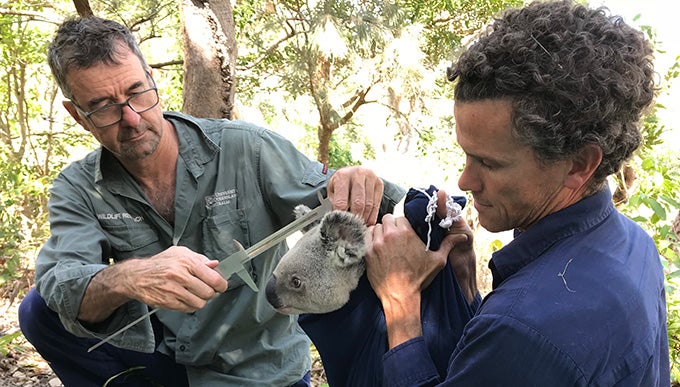
Koala Research at UQ
Protecting Australia's iconic koalas.
Koalas are one of Australia's most recognisable native species, yet their future is increasingly uncertain. As highly specialised feeders that rely almost exclusively on eucalyptus leaves, koalas are particularly vulnerable to habitat loss, disease, climate change, and other environmental pressures.
Listed as threatened in Queensland, New South Wales and the ACT, they face growing challenges across much of their historic range.
At The University of Queensland, researchers are leading innovative, multidisciplinary efforts to better understand and protect koala populations.
From investigating gut microbiomes, genetics and Koala Retrovirus (KoRV), to advancing wildlife health surveillance, reproductive technologies, epidemiology and field ecology, UQ scientists are developing evidence-based solutions to support koala conservation. Their work includes long-term population monitoring, non-invasive diagnostic tools, genetic biobanking, disease management programs, and cutting-edge applications of genomics, artificial intelligence and environmental DNA.
Together, these research initiatives are helping to improve koala health, resilience and long-term survival, ensuring that conservation strategies are informed by the best available science and designed to protect this treasured species for generations to come.
Koala research topics
- Health and ecology of koala populations across Queensland
- Koala sperm and egg bank conservation research
- Koalas on Australian islands: first database and exploration
- Research into the biology of koalas, their conservation and management
- Transforming koala conservation through evolutionary and genomic science
- Understanding Koala Retrovirus (KoRV)
- Understanding how environmental and management factors affect koala wellbeing
- Understanding of koala biology and disease including koala morbidity and mortality
- Understanding the koala microbiome