
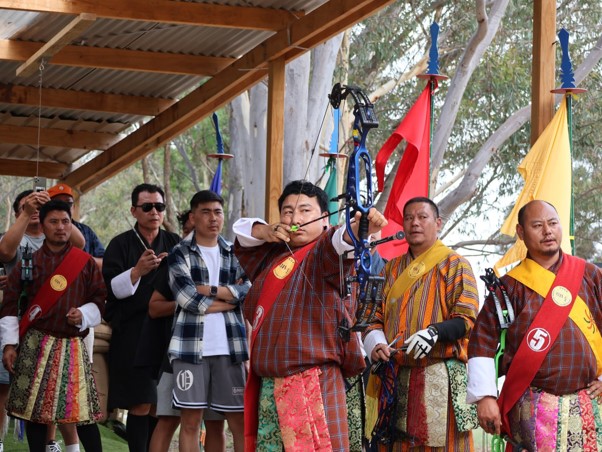
Air density has remained an under-examined variable in outdoor archery performance, until now.
Researchers from The University of Queensland and Bhutan’s Royal Thimphu College in collaboration with Archery Australia found daily changes in air density, driven by rising temperatures, can shift arrow landing points by up to 40 centimetres in Bhutanese archery, the Himalayan kingdom's national sport.
UQ lead researcher, Dr Boyd Wright from the School of the Environment said the study was the first to empirically examine air density's effect on arrow trajectory in any form of archery.
"Bhutanese archers told us they had noticed arrows flying differently as the day warmed up, but they didn't know whether to blame the air, their bow, or the person behind the bow," Dr Wright said.
To investigate, the research team including Dr Kezang Sherab from Royal Thimphu College, conducted an online survey of 97 Bhutanese archers while Dr James Park from Archery Australia developed iterative arrow-trajectory models to see how diurnal changes in air density might affect arrow range.
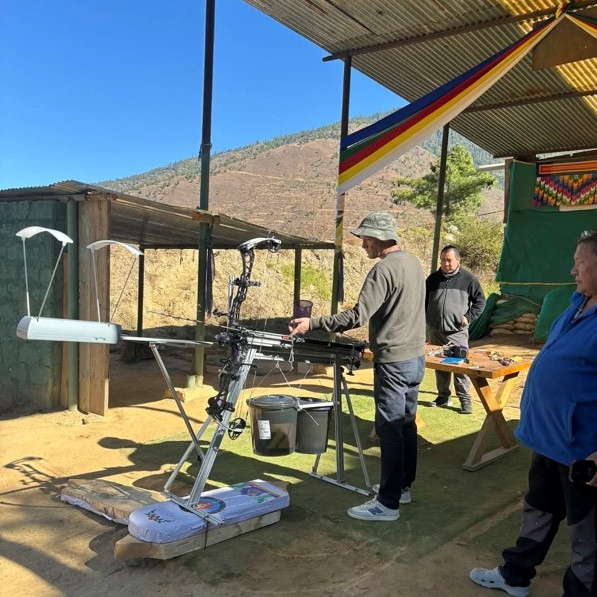
"We found that air density that falls as temperature rises throughout the day is the main culprit, and that its effects over a 145-metre range can be up to 40 cm, enough to make archers miss the target entirely if they don't adjust,” Dr Sherab said.
The research found that the impact is greatest on days with large temperature swings, in certain environments, and during full-day competitions where archers often face a great variety of atmospheric conditions.
For most archers who lack access to air-density instruments, temperature offers a practical on-field reference instead.
"Our models suggest that every 5°C rise in temperature corresponds to about a 0.1-metre increase in arrow range at 145 metres, a rule of thumb archers can actually use during a match," Dr Wright said.
The study also found that arrow design matters.
Thin, heavy arrows experienced the smallest air-density-related range shifts, while light, wide-diameter arrows were most affected.
"The good news is that equipment choices can reduce the problem, and simply shifting your shooting position a few metres, which is allowed under Bhutanese archery rules, is often enough to compensate for a full day's air-density variation," Dr Wright said.
Bhutanese archery is distinctive for its long-range shooting, all-day matches, and high-altitude mountain terrain.
It also presents the greatest mix of environmental challenges of any form of archery.

“Competitors have to contend with variables such as wind, changing lighting conditions, mirage effects, variations in air density, and differences in altitude,” Dr Wright said.
“In Bhutan, they sometimes even set up ranges across streams and gorges.
“These conditions amplify air-density effects beyond those encountered in most other archery disciplines.”
For archers who had spent careers adjusting by instinct and feel, the research offers a breakthrough framework for integrating air-density effects into stronger archery performance.
The research is published in Sage Journals


