
University of Queensland researchers have shown that a suite of low-cost, practical measures can significantly reduce the language barriers faced by non-native English speakers at international conferences.
Lead researcher, Associate Professor Tatsuya Amano from the School of the Environment, evaluated a series of interventions trialled at the 32nd International Congress for Conservation Biology 2025.
Held in Brisbane, the conference was hosted by the Society for Conservation Biology and Society for Conservation Biology Oceania and was attended by 1,890 delegates from 90 countries speaking 68 languages.
Dr Amano said English proficiency had long been treated as a prerequisite for full participation in international research, despite English being a first language for only a small fraction of the world's population.
"Failing to accommodate participants whose first language isn't English (approximately 95% of the global population) is not only inequitable, it's a huge loss to humanity," Dr Amano said.
"Diversity is key to scientific innovation and to resolving pressing global challenges.”
“Addressing language barriers is particularly important in conservation science because English is not widely spoken in biodiversity hotspots.”
Society for Conservation Biology Oceania Director, Micha Jackson, said that it is vital for the conservation community to make substantive efforts to be accessible to participants whose first language is not English.
“This supports broader efforts to make our discipline more inclusive and widens the extent of knowledge exchange that is so vital to addressing the conservation challenges of our times,” said Jackson.
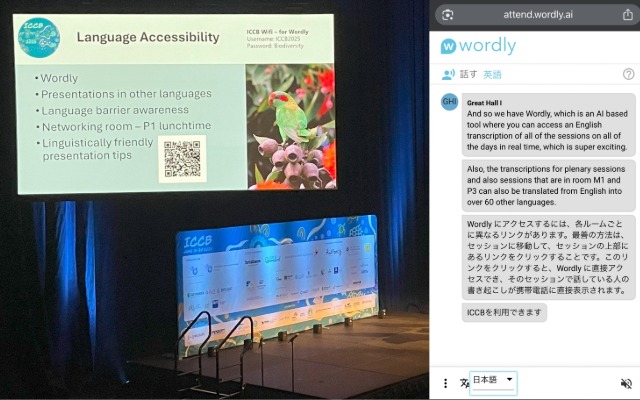
The research team led the conference's Language Accessibility Subcommittee, and combined artificial intelligence (AI) tools with human support to address barriers at every stage of the conference experience from submitting an abstract to networking on the sidelines.
At the pre-conference stage, linguistic support focused on lowering barriers to entry.
The subcommittee incorporated a machine translation plugin into the conference website, covering 12 languages, so that non-native English speakers could navigate the site in their own language.
To support the writing process itself, the team provided a free AI-based English editing tool for abstract writers, alongside editing software for all presenters giving participants practical help as they planned and prepared their submissions.
To ensure equity of submissions, reviewer guidelines were developed instructing assessors to judge submissions on scientific merit rather than English proficiency, alongside a "no rejection for poor language" policy.
During the conference, to support non-native English-speaking participants in understanding other participants’ presentations, the team provided live AI-based English transcriptions and translation of all oral presentations into over 60 languages.
This enabled the team to offer the option of oral presentations in a non-English language.
There were 2 delegates who chose to present in their own languages — Japanese and Indonesian — the first time this had happened in the conference's history.
Surveys conducted before and after the conference showed non-native English speakers reported significantly less difficulty preparing presentations and networking compared to previous conferences they had attended.
Benefits of the AI tools were also reported across other activities such as delivering talks and asking questions.
The live transcription and translation tool was used more than 2,100 times across the 5 day event and rated as the most valuable measure, with 4 in 5 users describing it as extremely or very helpful.
Despite the early success of lowering language barriers at the conference, the team cautioned that AI tools still need work.
During the conference, the team found the live translation system could not support many languages, including Indigenous languages spoken by some delegates.
Mistranslations of key terms were also reported by at least one non-English presenter.
"AI is not yet a silver bullet, we believe combining AI with human collaboration is essential while translation technology continues to improve, and we need to be mindful of the environmental costs of relying heavily on AI tools,” Dr Amano said.
Looking beyond the conference, the research trial is offering a blueprint for more inclusive science events worldwide.
“We hope that sharing our experiences, lessons learned, and areas for future expansion and improvement will be a useful support for other conference organisers,” said Jackson.
Dr Amano hopes these findings inspire scientists from diverse backgrounds to feel confident in sharing their research.
Language barriers, he argues, have long led the field to assume that valuable scientific insight only comes from fluent English speakers.
“That assumption has cost countless researchers the chance to be inspired by new ideas, and cost the world their voices, particularly from the regions where biodiversity is most threatened and conservation is most urgently needed.”
“We hope our experience shows that meaningful change is achievable, and encourages others to make their conferences more diverse, equitable and inclusive.”
The research is published in Nature Reviews Biodiversity
Collaboration and acknowledgements
The paper is co-authored by researchers from The University of Queensland, Queensland University of Technology, the University of Tasmania, The Society for Conservation Biology, and The Society for Conservation Biology Oceania.


