
A team from The University of Queensland's CoralWatch program has completed a 9-day journey across regional Queensland, sharing coral reef science to communities hundreds of kilometres from the coast.
CoralWatch is a citizen science program based in UQ's Centre for Marine Science, at The University of Queensland and has been engaging people in monitoring coral reef health for over 20 years.
The Outback to Ocean tour bought together CoralWatch staff, youth ambassadors, and guest scientist Professor Gregg Webb from the School of the Environment with the aim of raising awareness of reef conservation in regional communities.
Together, the team delivered 10 community events across 7 locations, engaging more than 555 people from Winton to Woppa (Great Keppel Island) highlighting the practical actions individuals can take to help protect reefs into the future.
CoralWatch Program Manager, Diana Kleine said that coral reefs have been part of Australia’s story for hundreds of millions of years and remnants of these ancient reefs can still be seen today in outback Queensland.
“Through our tour, outback communities are able to connect to the conversations about coral reefs and ocean conservation through coral skeletons, fossils, microscopes, virtual and, augmented reality experiences,” she said.
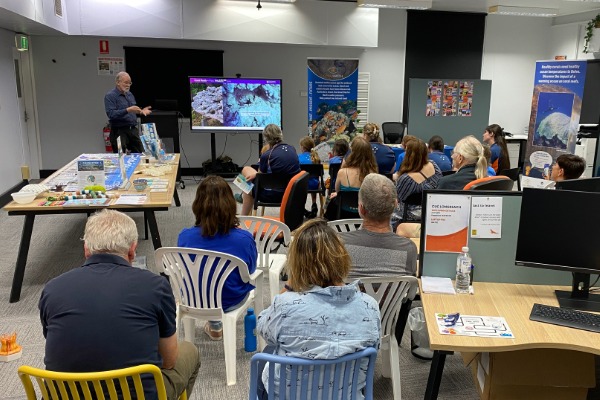
Professor Gregg Webb said that distance from the coast didn’t decrease people’s appreciation for the Great Barrier Reef.
“It is an Australian icon, and I think every Australian should feel some connection to it, the people we talked to in the Australian outback certainly did,” he said.
The tour began in Winton, a town more readily associated with dinosaur fossils and red earth than tropical coral.
Millions of years ago the region lay beneath the Eromanga Sea, making it a fitting starting point for a story that links Queensland's ancient inland waters to its living reefs today.
At the Winton Show, visitors examined coral skeletons under the microscope, tested their reef knowledge and explored the reef through virtual reality.
Many also met "Polly the Coral Polyp", a new augmented reality experience following one coral's journey through the 2024 mass bleaching event at Heron Reef.
The team also introduced a CoralWatch library resource, now availablefrom various places in the outback including Winton STEM HUB, Country Universities Centre Longreach, and Barcaldine and Yeppoon Libraries.
In Barcaldine, students explored how local fossils help scientists reconstruct the ancient inland sea that once covered western Queensland, and how that history connects to the evolution of the Great Barrier Reef.
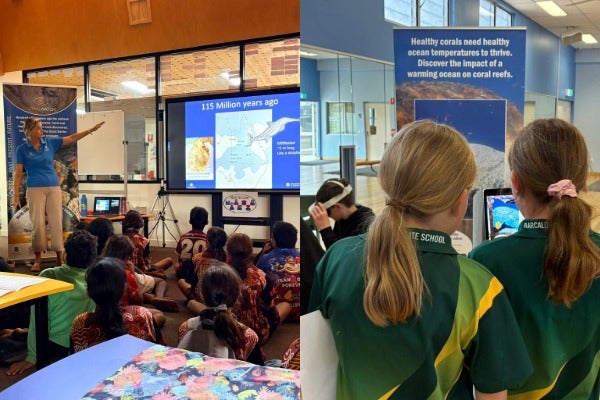
(R) Students from Barcaldine State School learning about coral bleaching through an Augmented Reality experience.
Activities included coral health surveys on a virtual reef, coding challenges with OzBots, reef-inspired art, and identification of fossils students brought from home.
The team joined the Barcaldine Country Women's Association to introduce CONNECTED, a community art-science project developed with Dr Anita Milroy that invites participants to help recreate the Heron Island reef, stitch by stitch.
A community evening in Longreach, hosted by the Country Universities Centre Longreach, drew families and a local Girl Guides group completing their Nature Badge, while Professor Webb spoke about the region's fossil record and its 100-million-year link to today's reefs.
At Ilfracombe State School, students compared ecological relationships in the ocean with those in their own landscape through a symbiosis game and reef colouring activities, while at Woorabinda Indigenous Community, around 50 students and 8 staff took part in a hands-on science session that also included cultural perspectives shared by Uncle Milton.
The largest event of the tour was held at Rockhampton Show Day, where a stage presentation and 2 interactive sessions reached 223 students and 16 teachers, delivered with support from CoralWatch Ambassadors and the Capricorn Conservation Council.
The tour concluded at Woppa (Great Keppel Island) with a citizen science community day held in partnership with the CoralWatch Yeppoon Youth Ambassadors and the Woppaburra TUMRA Aboriginal Corporation.
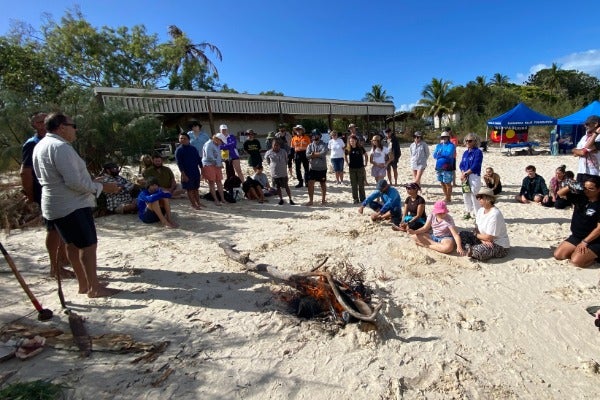
Reflecting on the tour, Professor Gregg hopes that people can think about their own footprint on the environment and how critical it is to protect our reefs.
“Awareness helps people wherever they are, make a positive difference, hopefully some will be inspired to take a Coral Health Chart on a holiday to the reef and contribute that way.
“All steps towards sustainability help everyone in the end because all environments are inextricably linked.
“Even where someone is not in an immediate position to carry out citizen science by monitoring coral health, the awareness of the science helps them make better decisions.”
Acknowledgements and collaborations
The CoralWatch Outback to Ocean tour is proudly supported by a Queensland Engaging Science Grant. Sincere thanks to our collaborators CUC RAPAD CWQ, Barcaldine Country Women’s Association, Woppaburra TUMRA Aboriginal Corporation, Woppaburra Saltwater Aboriginal Corporation RNTBC, Capricorn Conservation Council, Keppel Dive & Snorkel, Livingstone Shire Council.


