
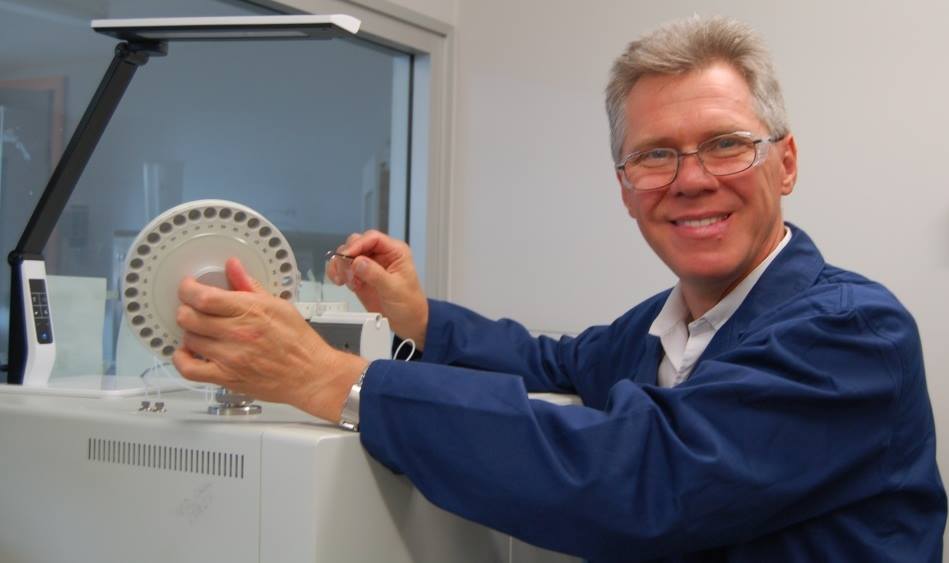
Dr Michael Nefedov enjoyed an extensive and accomplished scientific career, spanning 4 decades and 4 countries with 40 publications and 32 genomic libraries created.
The Michael Nefedov PhD Scholarship at The University of Queensland was created to give a future aspiring scientist the opportunity for a career just as rich and successful as his.
Michael completed a PhD in the genetics of breast cancer in 1988 at the All-Union Cancer Research Centre (Academy of Medical Science, Moscow, Russia), before spending 10 years at the Children’s Hospital in Oakland California working in genomics.
Michael also briefly worked as a Postdoctoral Research Fellow at the Institute for Molecular Biology and Biotechnology (McMaster University in Ontario, Canada) before joining UQ’s School of Chemistry and Molecular Biosciences in 2011, where he was Senior Scientific Officer for nearly a decade.
Reflecting on his journey, Michael said the advice he’d give his young researcher self is to work hard and put in the hours, but don’t ever be too proud to ask for advice.
“Don’t wait to figure everything out by yourself – you need professional advice and the more you learn, the more you realise how little you know.
“Remember your mentors are there to support you.”
The scholarship will be offered annually to a PhD student undertaking research into cancer.
Michael’s daughter, Dr Alexandra Nefedova, recently sat down with him to have a chat about his career.
From all of the work across your career, what is the most difficult technical procedure you performed?
Genomic libraries produced at the Children’s Hospital Oakland Research Institute (CHORI) were highly technical, with meticulous attention to detail and globally recognised results.
The laboratory, based in California, consisted of around 20 people and fostered extensive collaboration among various institutions.
The orangutan library was the largest of its kind ever created, which is why to this day I have a particular fondness for orangutans – they are among the most human-like creatures.
How long did it take to complete the genomic library?
People often think of genome sequencing as a quick, automated process. It reminds me of the story of Pablo Picasso when he was asked to draw a portrait, which he did in just 10 minutes.
When asked how much the portrait was worth, he gave a very high price and when questioned how it could be worth so much, he said, “Because it took me my whole life and 10 minutes to complete.”
Today, sequencing a human genome can take about a month, but that month rests on decades of scientific development, non-stop 24/7 lab work, and complex steps like sample preparation, replication and data analysis.
For context, the Human Genome Project took 13 years to produce the first draft, and even now – more than 20 years later – the human genome is still being refined.
Who was your favorite PhD student?
My favorite and most memorable student was at UQ.
He came from a non-scientific family and was initially hesitant to pursue a PhD.
I noticed he was an exceptional baker, so I put in a good word for him – if he could pay attention to detail in baking, he could apply the same care in the laboratory.
He went on to complete his PhD and performed very well.
What skills did you learn in your scientific career that you use in real life?
I use my skills every day because genomics and genetics underpin everything – genetics is fundamentally about life.
Through my work with orangutans, sheep and cane toads, I now travel the world learning about the animals whose genomes I helped preserve.
The rarest animal I’ve seen is the Madagascar fossa, and I can now share that knowledge in a fun way with my grandkids when they watch Madagascar.
Have you ever met anyone who benefited from the research you did?
In Moscow, I contributed to developing prenatal diagnosis for retinoblastoma, and for a long time up until recently my work was still being used to guide the diagnosis of children.
That’s a deeply meaningful accomplishment for me.
A scholarship is a wonderful way to celebrate life and legacy. To the student who receives it, it is so much more than financial support. It says, “We believe in you.”
If you’d like to invest in someone’s potential through a named scholarship, please contact Anthea Barry, Advancement Manager in the Faculty of Science


