
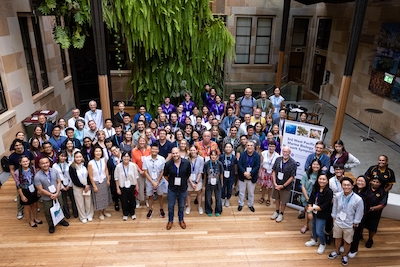
 A world-renowned symposium to understand, protect, and harness the potential of marine life in the Western Pacific has just successfully wrapped up at The University of Queensland.
Coordinated by UQ’s Centre for Marine Science, in collaboration with the National Centre for Scientific Research (CNRS) Biologie, the UQ–CNRS 3rd West Pacific Marine Biology Network Symposium was hosted this past November at UQ’s St Lucia campus.
Marine ecologist and event coordinator Associate Professor Karen Cheney said the symposium highlighted the extraordinary biodiversity of the Western Pacific Ocean.
“This region spans everything from coral reefs to temperate ecosystems, and supports globally significant fisheries and aquaculture industries,” she said.
“So we were absolutely thrilled to bring together a collective to help understand this incredibly valuable, biodiverse part of the world.
“We welcomed researchers at all career stages, providing a forum for students, postdoctoral fellows, early-career scientists and established academics to present their work, share knowledge and build new collaborations.
“The event brought together 110 delegates from across the Western Pacific region and beyond, with participants representing France, Singapore, Taiwan, Japan, New Zealand, the Philippines, the USA, Korea, Papua New Guinea and the UK, alongside strong local representation from UQ and other Australian universities.
“It was truly wonderful to see the symposium further strengthen scientific partnerships across these nations and the broader region.”
 The 2025 theme focused on the biological mechanisms underpinning organismal and ecosystem function and health.
“We had particular emphasis on how marine organisms develop, adapt and contribute to sustainable bioeconomies in the face of accelerating environmental change,” Dr Cheney said.
“Topics covered a broad scope of marine biology, ecology and evolution, including molecular, cellular and microbial biology; developmental biology; genomics and other omics; holobionts and microbiomes; eco-evo-devo; organismal and cellular communication and behaviour; sensory systems; and ecophysiology.”
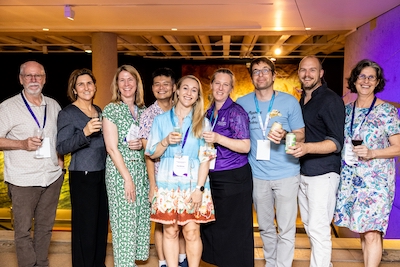
A dedicated session titled Weaving Currents of Knowledge: Respectful Partnerships Between Indigenous Peoples and Marine Scientists in the Indo-Pacific was one of the highlights in the programme.
The session featured presentations co-delivered by Indigenous marine scientists and Indigenous community collaborators, and a project leader from Papua New Guinea.
It showcased practical examples of partnership-driven research and the value of integrating Indigenous Knowledge systems with international marine science.
An ensuing panel discussion emphasised trust-building, co-design, and shared stewardship of cultural seascapes across the region.
The well-attended session provided opportunities to discuss important topics that are too often considered uncomfortable or hidden from view, Dr Benjamin Mos, co-presenter and session coordinator, said.
“Scientists and universities lose our social license when we fail to listen,” he said.
 “To address humanity’s greatest challenges - climate change, biodiversity loss, food security - we must move beyond silos and build genuine partnerships with Indigenous Peoples.
“Weaving diverse knowledge systems leads to innovative solutions grounded in respect, reciprocity, and resilience.
“Sessions like this showcase success and inspire others to collaborate with communities.”
Overall, the event showcased cutting-edge research and provided a valuable opportunity for participants to exchange ideas, foster new collaborations and advance understanding of marine systems across the Indo-Pacific.
The success of the symposium was made possible through the support of CNRS, the UQ Faculty of Science Associate Dean (Research), UQ Global and the Pacific Academy of Science.


